One day Online Program on "NEP 2020 AND ROLE OF LIFE SKILLS IN 21ST CENTURY EDUCATION"
About this program
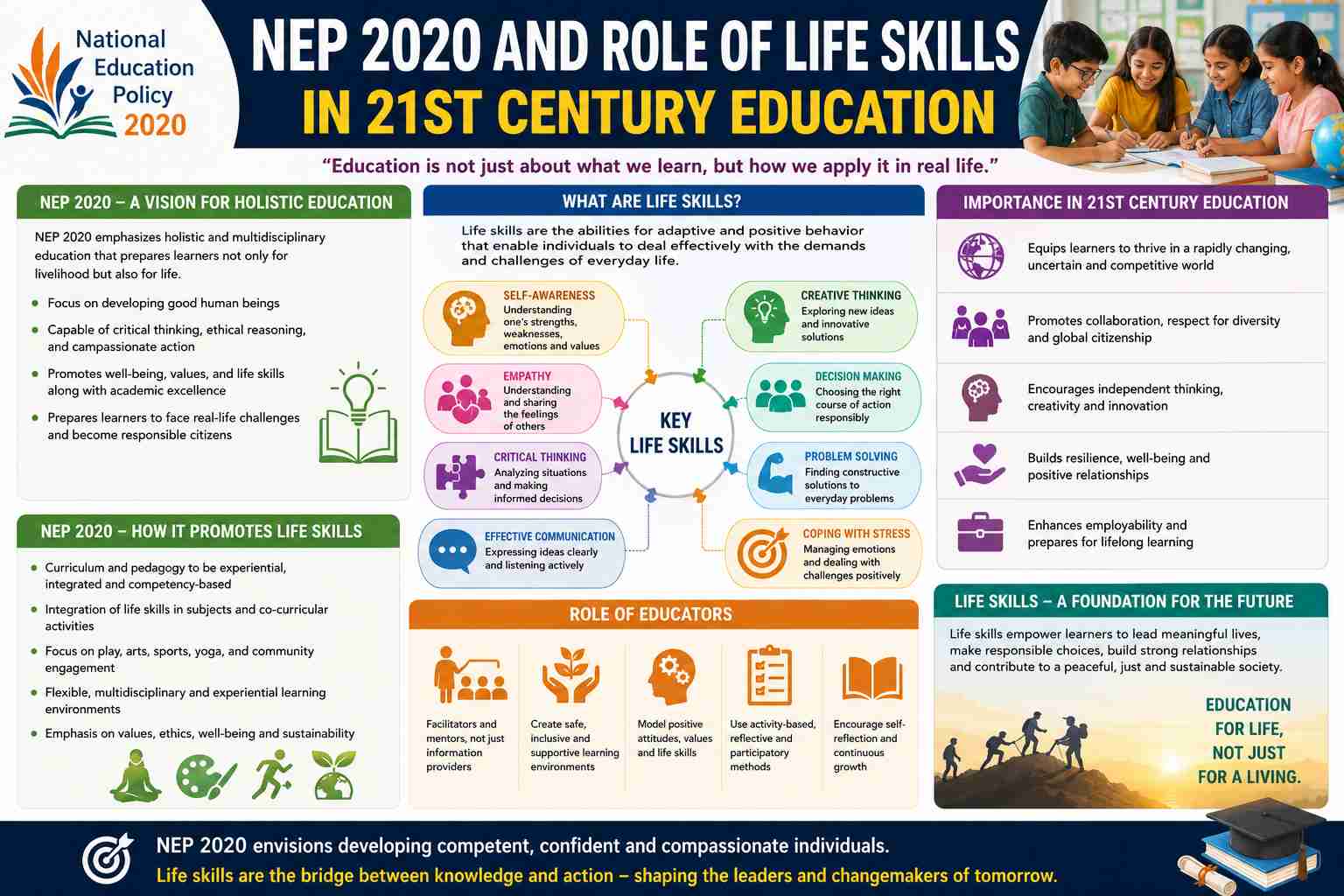
One day Online Program on "NEP 2020 AND ROLE OF LIFE SKILLS IN 21ST CENTURY EDUCATION" Date: 10th July 2026 Time: 04:30pm to 07:30pm NEP 2020 and the Role of Life Skills in 21st-Century Education: Education in the 21st century goes beyond academic achievement. It aims to prepare learners to solve problems, adapt to change, think critically, communicate well, and contribute responsibly to society. India’s National Education Policy (NEP) 2020 supports this goal through holistic, multidisciplinary, and competency-based education, with strong emphasis on life skills, values, creativity, and problem-solving. The National Education Policy (NEP) 2020 marks a major shift in Indian education. It focuses on experiential learning, critical thinking, creativity, and skill development rather than rote memorization. Key Features of NEP 2020 Related to Life Skills encompass Holistic and multidisciplinary education, Competency-based learning, Focus on critical thinking, creativity, and problem-solving, Communication, collaboration, and digital literacy, Vocational education and ethical values, Social-emotional learning and well-being. Life skills help learners manage everyday challenges and succeed in a changing world. They include decision-making, communication, empathy, coping with stress, and problem-solving. These skills help students Make informed decisions, work effectively with others, Adapt to social and technological change, manage emotions and stress, Become responsible and ethical citizens. Session 1 - Role of Curriculum and Teachers in Developing Life Skills among Learners Resource Person: Dr Manisha Khanna A good curriculum connects knowledge with real-life application. Hence the curriculum should include experiential and activity-based learning, integrate life skills across subjects, promote vocational education and value education, Support digital literacy, creativity, and inclusion. Teachers act as facilitators and role models in life skills development. Teachers can promote life skills by using learner-centered methods, encouraging questioning and collaboration, building confidence and self-esteem, promoting reflection and self-assessment, supporting emotional well-being. Session 2: Best Practices and Innovative Pedagogies for Life Skills Education Resource Person: Dr Santosh Pal, Assistant Professor in Education, K. P. Training College, Prayagraj Effective life skills education uses active and engaging methods such as experiential learning through real-life activities, project-based learning for teamwork and problem-solving, inquiry-based learning to build curiosity and critical thinking, collaborative learning for communication and cooperation, Role play and simulation for practical social skills, digital learning to improve technology use, service learning to build empathy and civic responsibility, social-emotional learning for self-awareness and emotional control, reflective learning through journals and portfolios. NEP 2020 recognizes that education must prepare learners for life, not just exams. By integrating life skills into the curriculum and using innovative teaching methods, schools can develop confident, creative, and responsible citizens. Teachers play a key role in making this vision a reality and in preparing students for the demands of the 21st century.