Online Webinar on "Integrating Sports and Arts in Teaching and Learning: A Pathway to Holistic Education and 21st Century Skills Development"
About this program
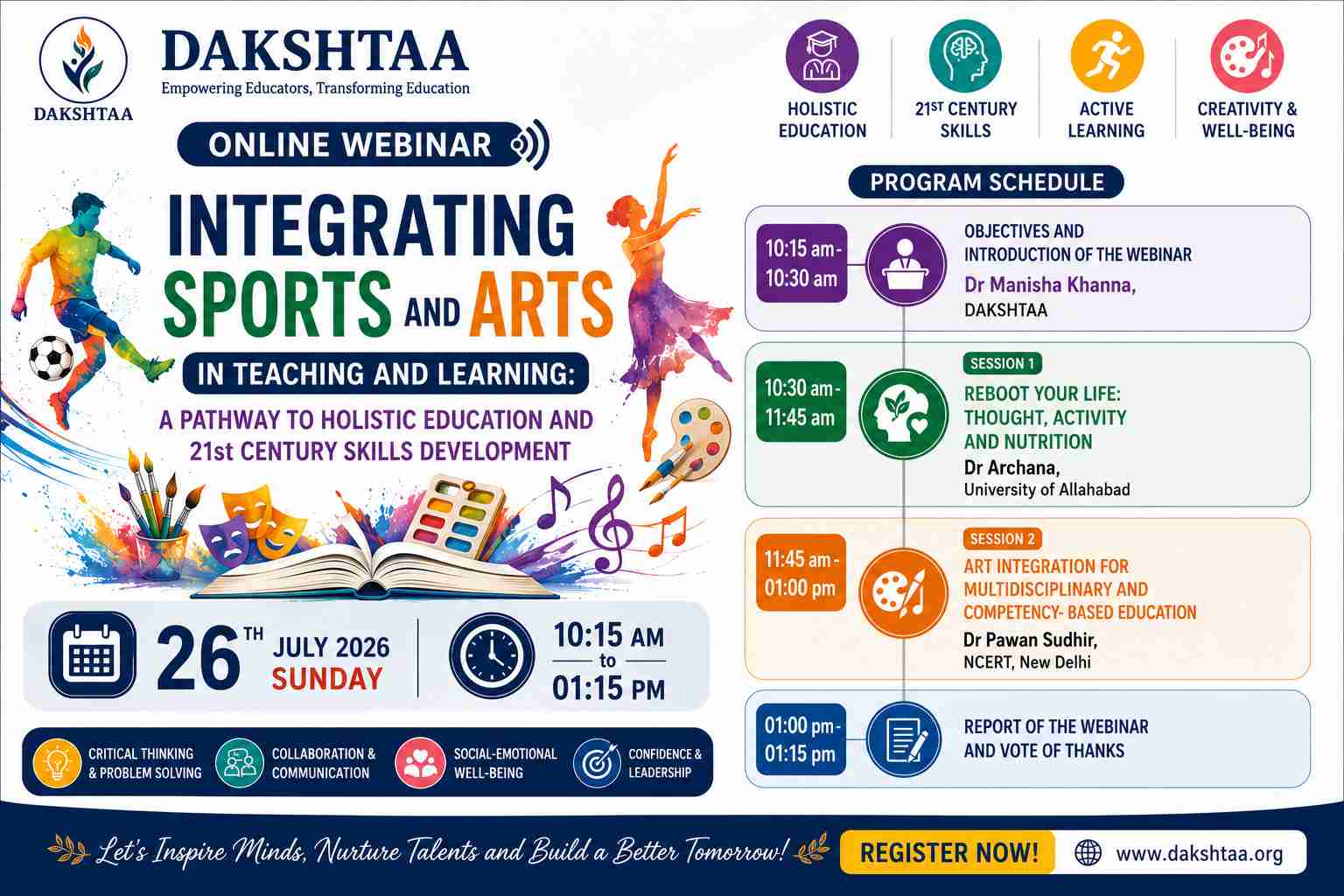
An Online Webinar on “Integrating Sports and Arts in Teaching and Learning: A Pathway to Holistic Education and 21st-Century Skills Development” Date: 26th July 2026 Time: 10:15 am to 01:15 pm 10:15 am - 10:30 am - Objectives and Introduction of the Webinar - Dr Manisha Khanna, DAKSHTAA. Session 1 - 10: 30 am to 11:45am - Dr Archana, University of Allahabad - Reboot your life: Thought, Activity and Nutrition. Session 2 - 11: 45 to 1:00 pm - Dr Pawan Sudhir, NCERT, New Delhi - Art Integration for Multidisciplinary and Competency- Based Education. 01:00 pm to 01:15 pm - Report of the Webinar and Vote of Thanks – Dr Manisha Khanna, DAKSHTAA. Education in the twenty-first century is undergoing a significant transformation, shifting from a content-driven approach to one that emphasizes the holistic development of learners. In today's rapidly changing world, academic knowledge alone is insufficient to prepare students for future challenges. Learners must develop creativity, critical thinking, communication, collaboration, resilience, adaptability, leadership, and emotional intelligence. Integrating sports and arts into teaching and learning provides an effective pathway for nurturing these competencies while promoting the overall physical, cognitive, emotional, social, and ethical development of students. Sports and arts are no longer viewed as merely extracurricular activities but as integral components of a comprehensive educational experience. Sports foster discipline, teamwork, perseverance, leadership, and healthy lifestyles. Participation in games and physical activities enhances concentration, decision-making, problem-solving abilities, and emotional resilience while instilling values such as fairness, respect, and cooperation. Similarly, arts—including music, dance, drama, visual arts, and creative writing—stimulate imagination, innovation, aesthetic appreciation, and self-expression. Arts-based learning enables students to explore ideas creatively, communicate effectively, develop empathy, and appreciate cultural diversity. Together, sports and arts create meaningful learning experiences that engage learners actively and make education more relevant, enjoyable, and inclusive. The National Education Policy (NEP) 2020 strongly advocates sports-integrated and art-integrated education as essential components of school curricula. The policy emphasizes experiential learning, competency-based education, and the elimination of rigid distinctions between curricular and extracurricular activities. By embedding sports and arts into everyday teaching, schools can create inclusive environments where every learner has opportunities to discover and develop individual talents while acquiring essential life skills. This approach aligns with global educational priorities promoted by UNESCO and other international organizations, which recognize holistic education as the foundation for sustainable development and global citizenship. Integrating sports and arts also plays a crucial role in promoting mental health and emotional well-being. Physical activity helps reduce stress and anxiety while improving self-esteem and overall fitness. Artistic expression provides healthy outlets for emotions, nurtures confidence, and encourages self-reflection. Together, they contribute to a positive school climate, strengthen peer relationships, and foster empathy, respect, and social responsibility among learners. These experiences prepare students not only for academic success but also for meaningful participation in society and the workforce. Despite the numerous benefits, successful implementation requires supportive policies, adequate infrastructure, trained teachers, flexible curricula, and appropriate assessment practices that recognize creativity, collaboration, participation, and personal growth alongside academic achievement. Continuous professional development, community partnerships, and parental involvement are equally important in creating vibrant learning ecosystems that value both intellectual excellence and holistic development. In conclusion, integrating sports and arts into teaching and learning is a powerful educational strategy for preparing learners to meet the demands of the twenty-first century. By combining academic learning with physical activity and creative expression, schools can cultivate confident, healthy, innovative, and socially responsible individuals equipped with the knowledge, skills, values, and attitudes needed to thrive in an increasingly dynamic and interconnected world. Such an approach transforms education from the mere transmission of information into a lifelong process of personal growth, creativity, collaboration, and responsible citizenship.