From Pages to Purpose - Building Life Skills Through Literature and Innovative Pedagogies
About this program
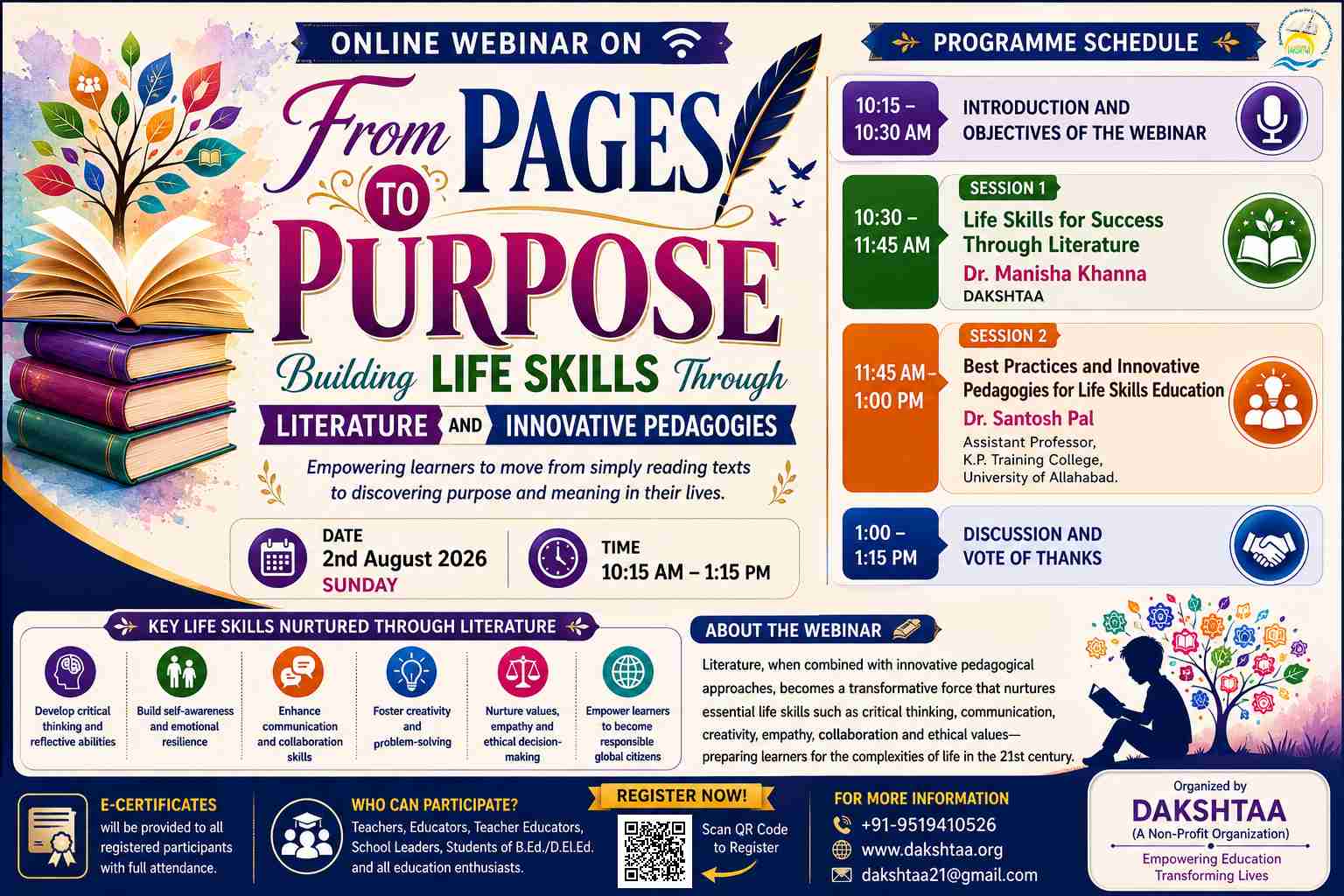
Online Webinar on "From Pages to Purpose - Building Life Skills Through Literature and Innovative Pedagogies" Date - 2nd August 2026, Sunday Time: 10:15 am to 1:15 pm. 10:15 to 10:30 - Introduction and objectives of the webinar. Session 1 - 10: 30am to 11:45 am - Life Skills for Success Through Literature – Dr. Manisha Khanna, DAKSHTAA. Session 2 - 11:45am to 1:00pm - Best Practices and Innovative Pedagogies for Life Skills Education. - Dr. Santosh Pal, Assistant Professor, K.P. Training College, University of Allahabad. 1:00pm to 1:15pm Discussion and Vote of Thanks The twenty-first century education extends far beyond the acquisition of knowledge. It envisages to prepare learners for the complexities of life by nurturing the skills, values, and attitudes necessary for personal, social, and professional success. Since time immemorial, literature has emerged as an influential educational tool that not only enriches language and imagination but also cultivates essential life skills. By juxtaposing, innovative pedagogical approaches, literature becomes a transformative force that guides students from simply reading texts to discovering purpose and meaning in their lives. Literature is a mosaic of myriad reflections of human experiences, emotions, and cultures. Through stories, poems, novels, and plays, learners encounter diverse characters, situations, and perspectives that encourage them to think critically and empathetically. An exploration of themes such as courage, resilience, justice, compassion, and identity, students begin to understand themselves and others more deeply. This process of reflection fosters emotional intelligence, ethical decision-making, and respect for diversity—qualities that are fundamental to responsible citizenship. Several key life skills are inculcated through the study of literature. Critical thinking is heightened as students interpret texts, analyse characters' motivations, and evaluate different viewpoints through the constructivist approach. Communication skills improve through discussions, debates, presentations, and creative writing activities. Collaborative learning encourages teamwork and leadership, while reflective reading promotes self-awareness and emotional resilience. Literature also nurtures creativity by inspiring learners to imagine possibilities, solve problems, and express their ideas confidently. The effectiveness of life Skills Education is greatly strengthened through innovative pedagogies that place learners at the centre of the learning process. Traditional lecture-based teaching is increasingly being complemented by Learner -centred approach, through interactive methods such as storytelling, role play, drama, project-based learning, inquiry-based learning, flipped classrooms, digital storytelling, and experiential learning. These approaches make literary texts more engaging and relevant, allowing students to actively participate in constructing knowledge rather than passively receiving information. The expedition from pages to purpose is ultimately an expedition of transformation. Literature provides the wisdom of human experience, while innovative pedagogies enable students to engage with that wisdom actively and meaningfully. Thus, they empower learners to become thoughtful thinkers, compassionate individuals, effective communicators, and responsible global citizens.