
Framing Questions and Setting a Balanced Question Paper
About this program
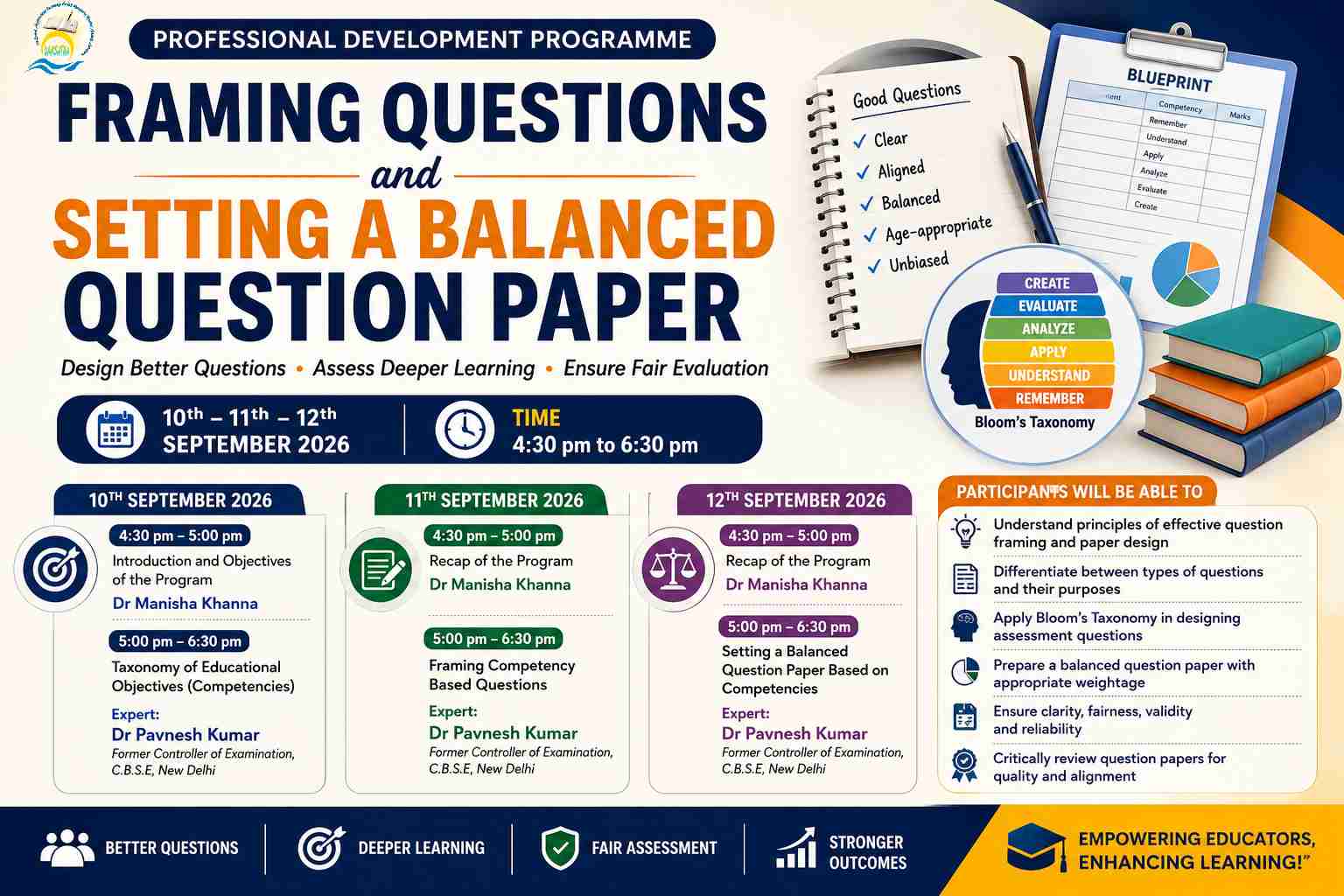
“Framing Questions and Setting a Balanced Question Paper” Date: 28th – 29th – 30th September 2026 Time: 4:30 pm to 6:30 pm Date: 28th September 2026 4:30 pm to 5:00 pm - Introduction and Objectives of the program: Dr Manisha Khanna 5:00 pm to 6:30 pm – Taxonomy of Educational Objectives (Competencies) Expert: Dr Pavnesh Kumar, Former Controller of Examination, C.B.S.E, New Delhi Date: 29th September 2026 4:30 pm to 5:00 pm – Recap of the program: Dr Manisha Khanna 5:00 pm to 6:30 pm – Framing Competency Based Questions Expert: Dr Pavnesh Kumar, Former Controller of Examination, C.B.S.E, New Delhi Date: 30th September 2026 4:30 pm to 5:00 pm – Recap of the program: Dr Manisha Khanna 5:00 pm to 6:30 pm – Setting a Balanced Question Paper based on Competencies Expert: Dr Pavnesh Kumar, Former Controller of Examination, C.B.S.E, New Delhi Framing Questions and Setting a Balanced Question Paper Objectives By the end of the Professional Development Programme, participants will be able to: 1. Understand the principles and purpose of effective question framing and question paper design. 2. Identify different types of questions according to learning objectives and cognitive levels. 3. Develop questions that assess knowledge, understanding, application, analysis, evaluation and creativity. 4. Prepare a balanced question paper covering appropriate content, competencies and learning outcomes. 5. Ensure proper distribution of questions according to marks, difficulty level and cognitive demand. 6. Frame clear, precise, age-appropriate and unbiased questions. 7. Prepare questions that assess both conceptual understanding and practical application. 8. Develop appropriate objective-type, short-answer and extended-response questions. 9. Use a blueprint or test specification table to ensure balanced coverage of the syllabus. 10. Review and improve question papers for validity, reliability, clarity and fairness. Learning Outcomes After completing the PDP, participants will be able to: • Explain the principles of effective question framing. • Differentiate between various types of questions and their purposes. • Frame questions aligned with specified learning outcomes. • Apply Bloom’s Taxonomy while designing assessment questions. • Prepare a balanced question paper with appropriate weightage. • Maintain a suitable balance of easy, moderate and challenging questions. • Ensure adequate coverage of prescribed content and competencies. • Identify ambiguity, repetition, bias and inappropriate difficulty in questions. • Prepare a question paper blueprint before finalising the assessment. • Critically review a question paper for quality, fairness and alignment with learning objectives.