
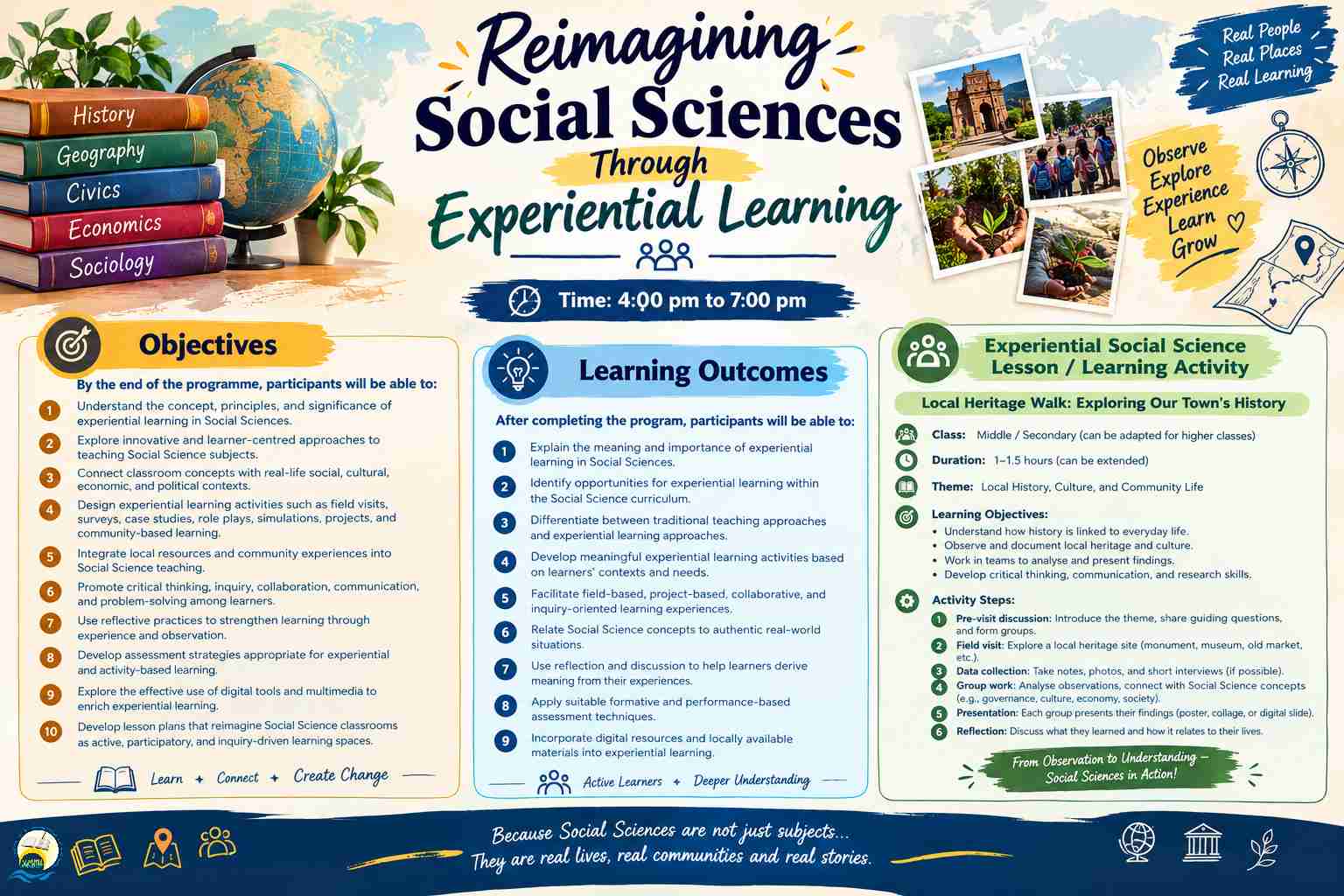
NEP 2020 and NCFSE 2023 : Reimagining Social Sciences Through Experiential Learning
About this program
“NEP 2020 and NCFSE 2023 : Reimagining Social Sciences Through Experiential Learning” Date: 25th -26th October 2026 Time: 4:00 pm to 7:00 pm Date: 25th October 2026 4:00 pm to 4:30 pm - Introduction and Objectives of the program: Dr Manisha Khanna, DAKSHTAA 4:30 pm to 5:45 pm – Reimagining History Education Through Experiential Learning: Storytelling, Heritage and Historical Inquiry. Expert. Mrs. Neera Kohli, Resource Person, CBSE, New Delhi. 5:45 pm to 7:00 pm Democratic and Participatory Political Science: Simulations, Debates and Civic Engagement Expert: Dr. Jyoti Baijal, Assistant Professor, S. S. Khanna Girl's Degree College, University of Allahabad, Prayagraj. Date: 26th October 2026 4:00 pm to 4:30 pm - Recap of the program: Dr Manisha Khanna 4:30 pm to 5:45 pm – Experiential and Geospatial Learning in Geography: Integrating Fieldwork, GIS and Digital Technologies. Expert: Prof. Anita Nuna, Ex. Professor, Curriculum Studies, NCERT, New Delhi. 5:45 pm to 7:00 pm - Making Economics Meaningful Through Experiential and Activity Based Learning: Simulations, Data and Real-World Applications. Expert: Dr. Ashita Raveendran, Associate Professor, NCERT, New Delhi Reimagining Social Sciences through Experiential Learning Objectives By the end of the programme, participants will be able to: 1. Understand the concept, principles, and significance of experiential learning in Social Sciences. 2. Explore innovative and learner-centred approaches to teaching Social Science subjects. 3. Connect classroom concepts with real-life social, cultural, economic, and political contexts. 4. Design experiential learning activities such as field visits, surveys, case studies, role plays, simulations, projects, and community-based learning. 5. Integrate local resources and community experiences into Social Science teaching. 6. Promote critical thinking, inquiry, collaboration, communication, and problem-solving among learners. 7. Use reflective practices to strengthen learning through experience and observation. 8. Develop assessment strategies appropriate for experiential and activity-based learning. 9. Explore the effective use of digital tools and multimedia to enrich experiential learning. 10. Develop lesson plans that reimagine Social Science classrooms as active, participatory, and inquiry-driven learning spaces. Learning Outcomes After completing the program, participants will be able to: 1. Explain the meaning and importance of experiential learning in Social Sciences. 2. Identify opportunities for experiential learning within the Social Science curriculum. 3. Differentiate between traditional teaching approaches and experiential learning approaches. 4. Develop meaningful experiential learning activities based on learners' contexts and needs. 5. Facilitate field-based, project-based, collaborative, and inquiry-oriented learning experiences. 6. Relate Social Science concepts to authentic real-world situations. 7. Use reflection and discussion to help learners derive meaning from their experiences. 8. Apply suitable formative and performance-based assessment techniques. 9. Incorporate digital resources and locally available materials into experiential learning. 10. Prepare an experiential Social Science lesson or learning activity that promotes active learner participation.