Arts Integrated Learning: A Pathway to Essential Life Skills
About this program
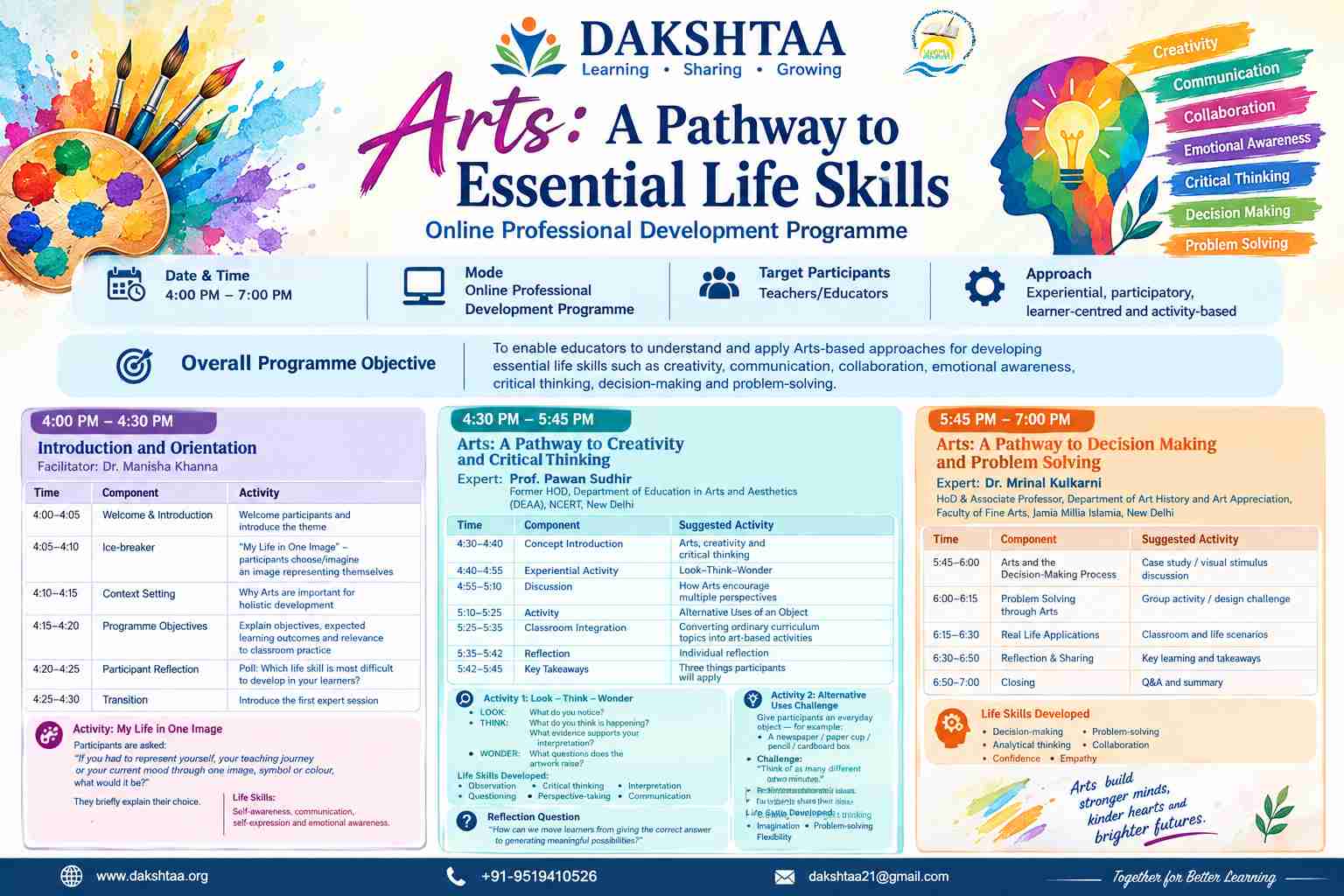
“Arts Integrated Learning : A Pathway to Essential Life Skills” Date: 10th October 2026 Time: 4:00 pm to 7:00 pm 4:00 pm to 4:30 pm - Introduction and Objectives of the program: Dr Manisha Khanna 4:30 pm to 5:45 pm: Arts Integrated Learning : A Pathway to Creativity and Critical Thinking Expert: Prof. Pawan Sudhir, Former HOD, Department of Education in Arts and Aesthetics (DEAA), NCERT, New Delhi. 5:45 pm to 7:00 pm: Arts Integrated Learning : A Pathway to Decision Making and Problem Solving Expert: Dr. Mrinal Kulkarni, HoD and Associate Professor, Department of Art History and Art Appreciation, Faculty of Fine Arts, Jamia Millia Islamia, New Delhi. Arts: A Pathway to Life Skills Objectives By the end of the programme, participants will be able to: 1. Understand the role of Arts in developing essential life skills among learners. 2. Explore how different forms of art can foster creativity, self-expression, and emotional awareness. 3. Integrate visual arts, music, theatre, dance, storytelling, and craft into educational practices. 4. Develop learners' communication, collaboration, and interpersonal skills through art-based activities. 5. Use Arts to promote critical thinking, imagination, problem-solving, and decision-making. 6. Encourage self-confidence, empathy, sensitivity, and respect for diverse perspectives through creative expression. 7. Design experiential and learner-centred activities that connect Arts with real-life situations. 8. Use artistic activities to support emotional well-being and positive self-expression. 9. Develop inclusive art-based activities that encourage participation and appreciation of individual differences. 10. Apply appropriate assessment strategies to evaluate life skills developed through Arts-based learning. Learning Outcomes After completing the program, participants will be able to: 1. Explain the relationship between Arts education and the development of life skills. 2. Identify different life skills that can be developed through artistic activities. 3. Design art-based activities that promote creativity, communication, and collaboration. 4. Use theatre, storytelling, music, dance, and visual arts to develop self-expression. 5. Facilitate activities that enhance learners' confidence and interpersonal relationships. 6. Apply art-based approaches to develop empathy, emotional awareness, and social sensitivity. 7. Encourage learners to use creative thinking and problem-solving in everyday situations. 8. Develop inclusive and participatory learning experiences through Arts. 9. Use reflection and feedback to help learners recognise their personal growth and strengths. 10. Prepare lesson plans and activities that integrate Arts with relevant life skills.