
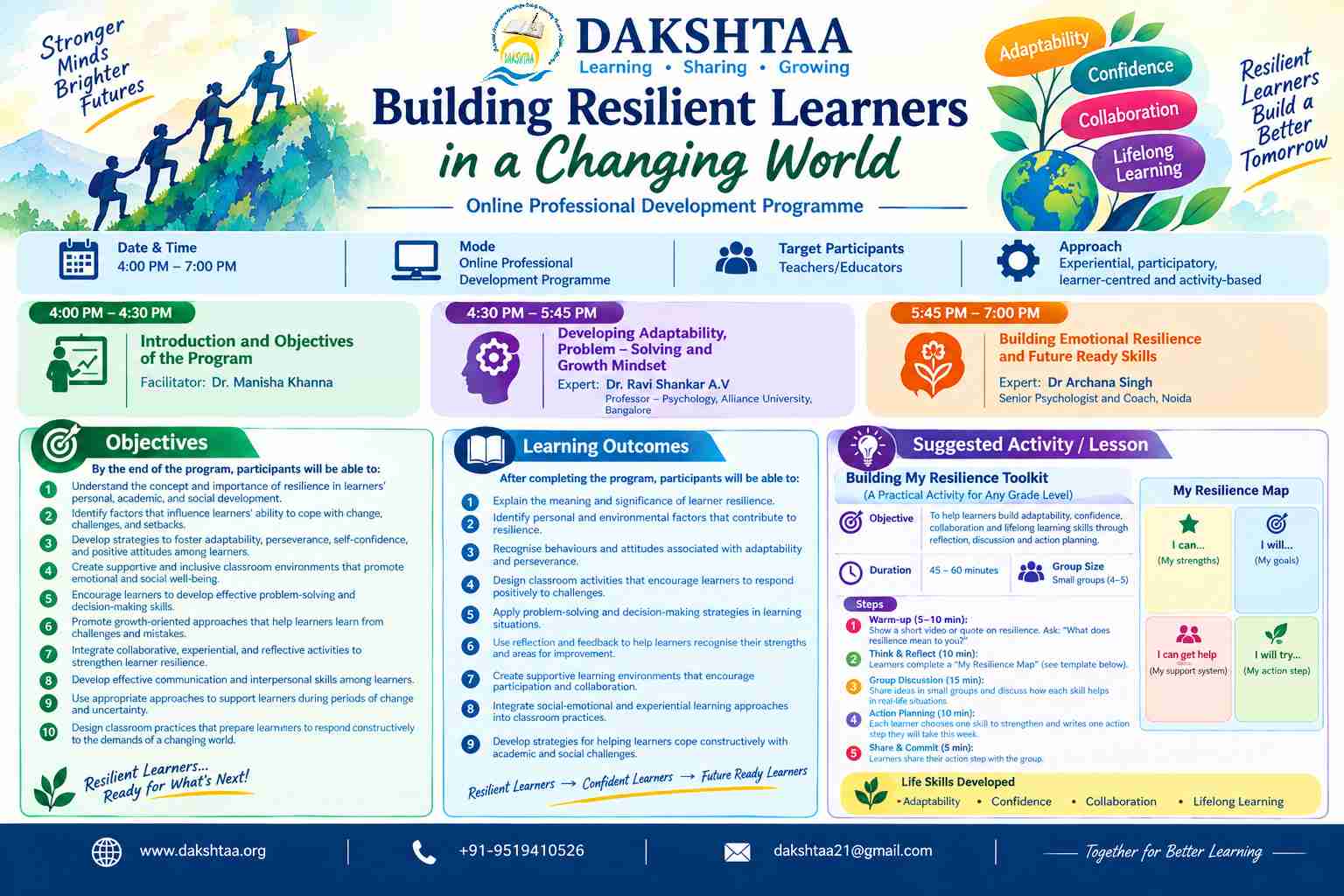
Building Resilient Learners in a Changing World
About this program
“Building Resilient Learners in a Changing World” Date: – 15th October 2026 Time: 4:00 pm to 7:00 pm 4:00 pm to 4:30 pm - Introduction and Objectives of the program: Dr Manisha Khanna 4:30 pm to 5:45 pm: Developing Adaptability, Problem – Solving and Growth Mindset Expert: Dr. Ravi Shankar A.V, Professor – Psychology, Alliance University, Bangalore 5:45 pm to 7:00 pm: Building Emotional Resilience and Future Ready Skills Expert: – Dr Archana Singh, Senior Psychologist and Coach, Noida Building Resilient Learners in a Changing World Objectives By the end of the program, participants will be able to: 1. Understand the concept and importance of resilience in learners' personal, academic, and social development. 2. Identify factors that influence learners' ability to cope with change, challenges, and setbacks. 3. Develop strategies to foster adaptability, perseverance, self-confidence, and positive attitudes among learners. 4. Create supportive and inclusive classroom environments that promote emotional and social well-being. 5. Encourage learners to develop effective problem-solving and decision-making skills. 6. Promote growth-oriented approaches that help learners learn from challenges and mistakes. 7. Integrate collaborative, experiential, and reflective activities to strengthen learner resilience. 8. Develop effective communication and interpersonal skills among learners. 9. Use appropriate approaches to support learners during periods of change and uncertainty. 10. Design classroom practices that prepare learners to respond constructively to the demands of a changing world. Learning Outcomes After completing the program, participants will be able to: 1. Explain the meaning and significance of learner resilience. 2. Identify personal and environmental factors that contribute to resilience. 3. Recognise behaviours and attitudes associated with adaptability and perseverance. 4. Design classroom activities that encourage learners to respond positively to challenges. 5. Apply problem-solving and decision-making strategies in learning situations. 6. Use reflection and feedback to help learners recognise their strengths and areas for improvement. 7. Create supportive learning environments that encourage participation and collaboration. 8. Integrate social-emotional and experiential learning approaches into classroom practices. 9. Develop strategies for helping learners cope constructively with academic and social challenges. 10. Prepare a resilience-focused lesson or activity that promotes adaptability, confidence, collaboration, and lifelong learning.